
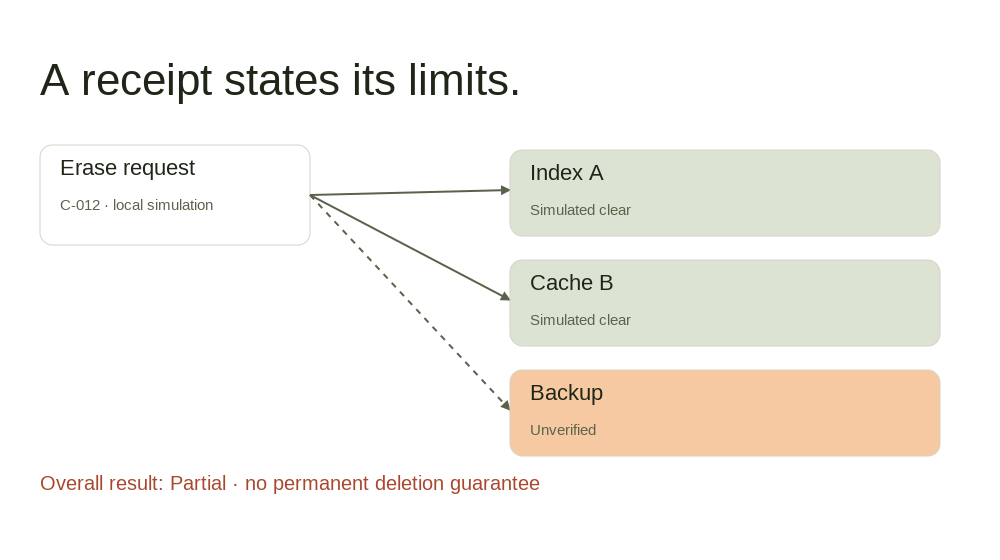
Start with the destinations
A memory may appear in more places than the primary store. Build an inventory around the fact, subject and purpose you want to inspect.
- Primary memory store and replicas
- Derived search indexes and embeddings
- Response and application caches
- Exports, logs and downstream consumers
- Backup retention and restoration paths
Name what each check establishes
Separate an API acknowledgement from a read-after-delete result. A negative retrieval result covers that named path at that moment; it does not establish the state of backups or exports.
- Record the request and subject scope
- Name the destination and owner
- Capture the acknowledgement
- Record the specific retrieval path tested
- Preserve the exclusions and unknowns
Give restoration its own boundary
Ask what happens when a backup is restored. Does a prior erasure decision propagate again? Who verifies that behavior? Keep the answer separate from the active-index check.
Bring a map, not a promise.
A useful review names the destinations, the owner and the next question.
Prepare an assessment