01
01
Attach the policy
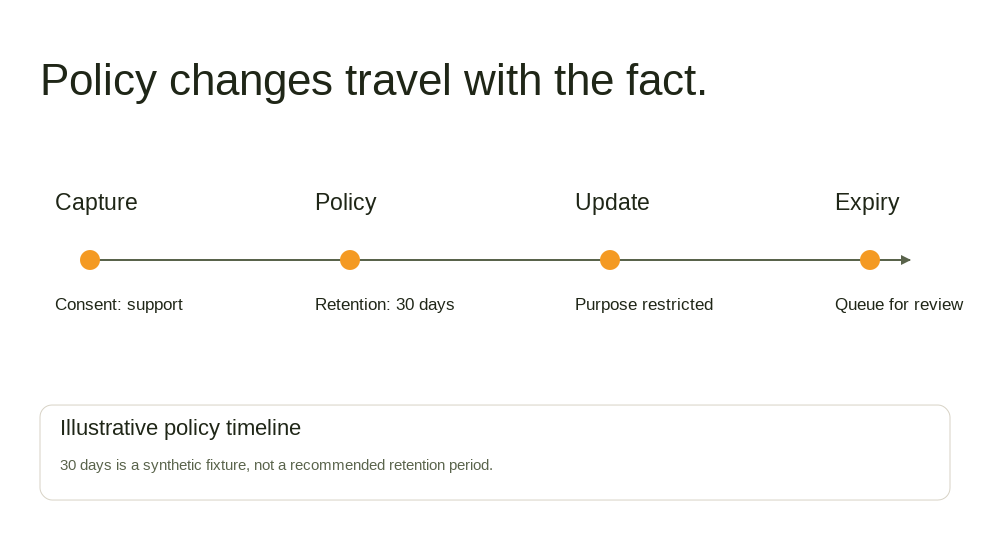
Tie the fact to a purpose, consent state and retention rule. Preserve the policy version used for the decision.

Memory Proof / Carry consent and retention forward
Bring retention schedules and consent changes into the memory lifecycle. See the policy, the deadline and the destinations still waiting to acknowledge it.
The question it owns
Tie the fact to a purpose, consent state and retention rule. Preserve the policy version used for the decision.
What you inspect
01
Tie the fact to a purpose, consent state and retention rule. Preserve the policy version used for the decision.
02
A scheduled expiry and a consent withdrawal are different triggers. Show which one applies and when.
03
Follow acknowledgements across destinations. A policy change is only as clear as its unresolved boundaries.
The edge case matters
Keep the outstanding destination visible and assign a review owner. An expiry timestamp does not establish that every copy disappeared.
Define the acceptance criteriaKeep the outstanding destination visible and assign a review owner. An expiry timestamp does not establish that every copy disappeared.
A readable workflow
See the relationship between the input, the decision and the record that follows.
Part of the whole story
Source, scope, policy and evidence stay related across the Factmend product family. Explore the responsibility that follows.
Memory Signal
The pilot should start with one question: When does this memory stop belonging? Agree on a fixture, the native behavior and a reviewable acceptance criterion before testing.
That is the intended starting point. Identify the native controls, destinations and API boundaries. Adapter and deployment behavior need to be confirmed for your environment.
The workspace provides local sample interactions for Memory Proof, using fictional records. Production connectivity and product access are still being developed.

A clearer next step
Bring your memory stack, your hardest question
and the boundaries you want to test.