01
01
Package the context
Export the value together with subject, tenant, purpose and source references. Keep the schema and version visible.

Memory Report / Move memory with its context
Package facts with scope, lineage, versions and policies. Give migrations a readable manifest and a test plan for retrieval quality.
The question it owns
Export the value together with subject, tenant, purpose and source references. Keep the schema and version visible.
What you inspect
01
Export the value together with subject, tenant, purpose and source references. Keep the schema and version visible.
02
Compare the receiving system’s scoping, policy and version semantics. A valid file does not guarantee equivalent behavior.
03
Run the same scoped questions before and after migration. Record acceptance criteria and unresolved differences.
The edge case matters
Confirm that purpose restrictions, version selection and expiry behave as intended in the destination. Retrieval quality remains a measured test.
Define the acceptance criteriaConfirm that purpose restrictions, version selection and expiry behave as intended in the destination. Retrieval quality remains a measured test.
A readable workflow
See the relationship between the input, the decision and the record that follows.
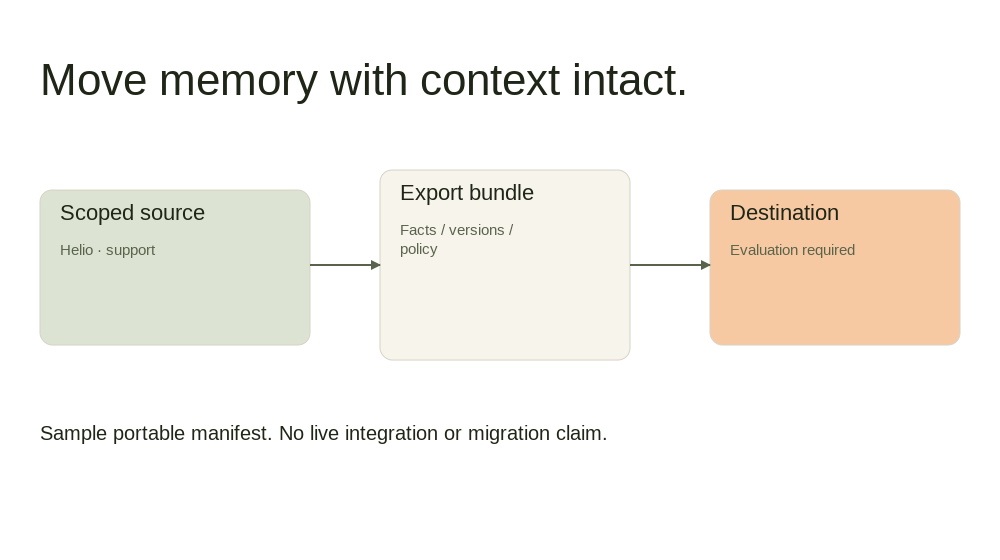
Part of the whole story
Source, scope, policy and evidence stay related across the Factmend product family. Explore the responsibility that follows.
Memory Desk
The pilot should start with one question: What travels with the fact? Agree on a fixture, the native behavior and a reviewable acceptance criterion before testing.
That is the intended starting point. Identify the native controls, destinations and API boundaries. Adapter and deployment behavior need to be confirmed for your environment.
The workspace provides local sample interactions for Memory Report, using fictional records. Production connectivity and product access are still being developed.

A clearer next step
Bring your memory stack, your hardest question
and the boundaries you want to test.