01
01
Follow the source
Inspect the original excerpt and the moment a preference was learned. Keep attribution attached to the value.

Memory Review / Keep the source and the changes
Connect the current value to the conversation that changed it. Inspect versions, resolve contradictions and keep a clear reviewer decision.
The question it owns
Inspect the original excerpt and the moment a preference was learned. Keep attribution attached to the value.
What you inspect
01
Inspect the original excerpt and the moment a preference was learned. Keep attribution attached to the value.
02
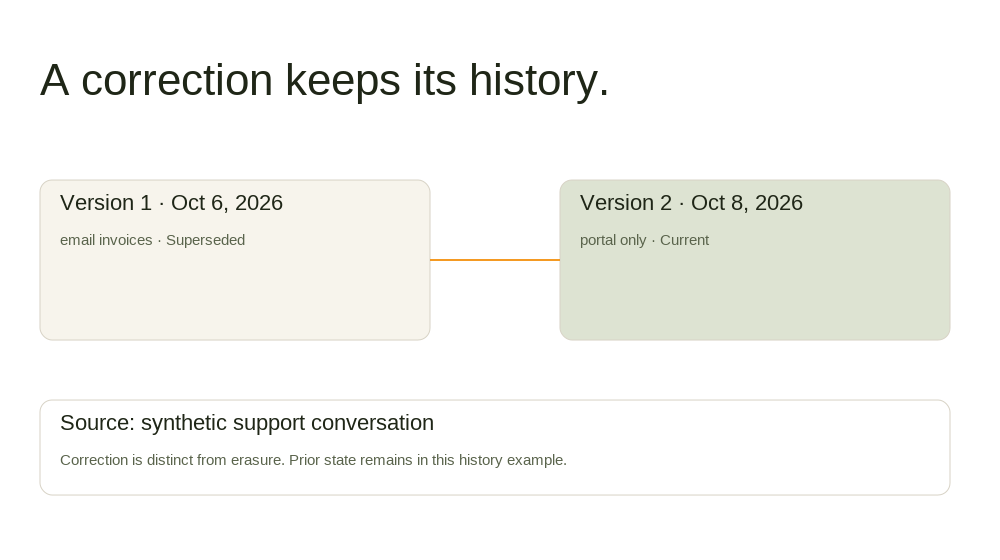
See “email invoices” next to “portal only.” A newer timestamp is a reason to review, not an automatic guarantee of truth.
03
Approve the correction, retain the earlier version as history, and make the new retrieval value explicit.
The edge case matters
A contradiction remains unresolved until a reviewer has enough context. Show the conflicting values rather than silently selecting one.
Define the acceptance criteriaA contradiction remains unresolved until a reviewer has enough context. Show the conflicting values rather than silently selecting one.
A readable workflow
See the relationship between the input, the decision and the record that follows.
Part of the whole story
Source, scope, policy and evidence stay related across the Factmend product family. Explore the responsibility that follows.
Memory Proof
The pilot should start with one question: What changed, and why? Agree on a fixture, the native behavior and a reviewable acceptance criterion before testing.
That is the intended starting point. Identify the native controls, destinations and API boundaries. Adapter and deployment behavior need to be confirmed for your environment.
The workspace provides local sample interactions for Memory Review, using fictional records. Production connectivity and product access are still being developed.

A clearer next step
Bring your memory stack, your hardest question
and the boundaries you want to test.